Most disappointing AI rollouts have the same root cause: the model is fine, but the information it can access is messy, stale, duplicated, or impossible to trust.
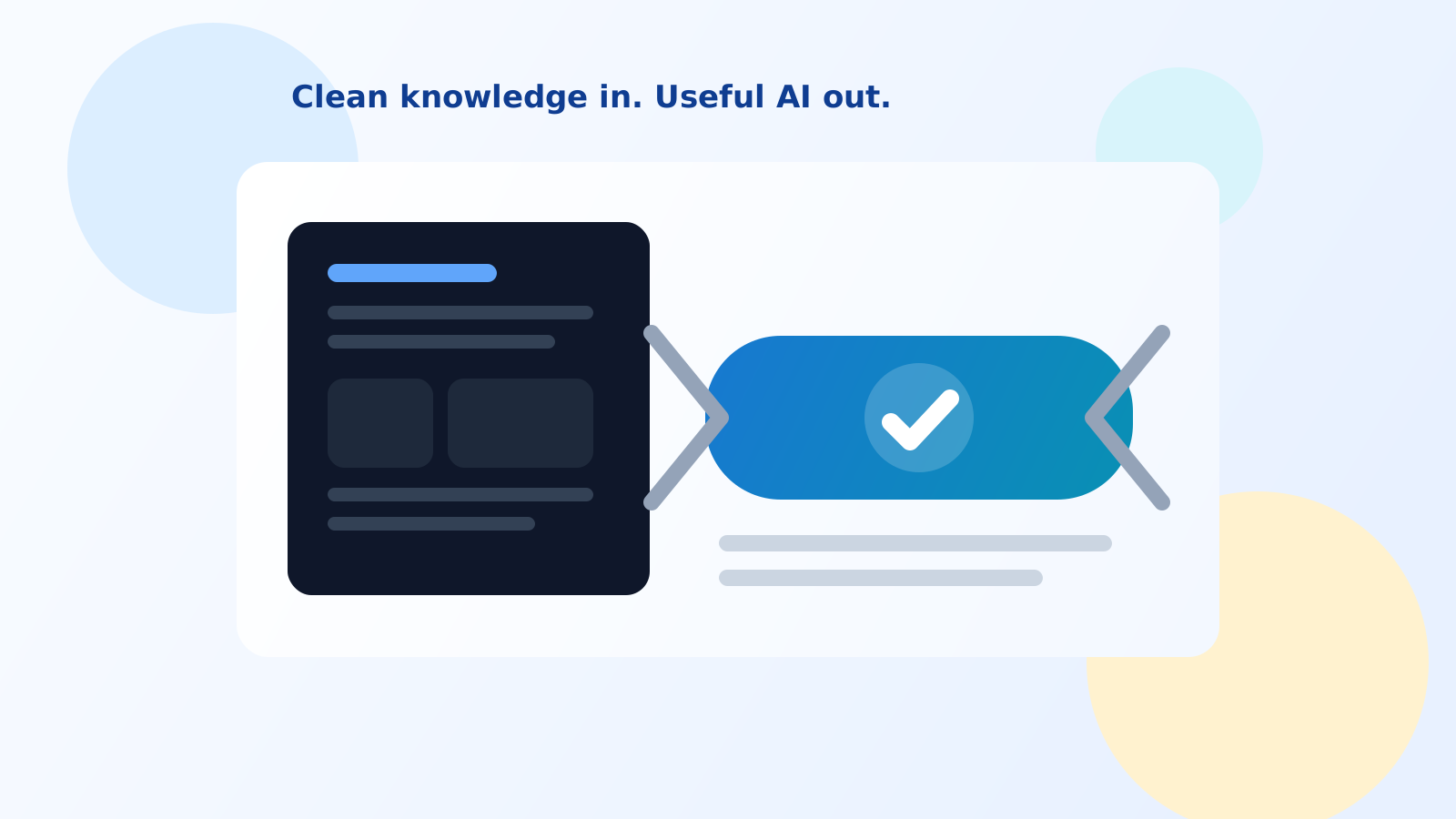
If your company knowledge is fragmented, your AI does not become smarter. It becomes faster at repeating the fragmentation back to your team.
The real problem usually is not the model
Teams often buy an AI assistant after a strong demo and expect immediate leverage. Then the pilot hits production reality: answers conflict with policy, documents are out of date, and employees still need to verify everything manually.
That is not a model-quality problem first. It is a knowledge-quality problem.
AI systems are excellent at retrieving, summarizing, and transforming information. They are much less forgiving when the underlying material is inconsistent. If three sources say different things, the system still has to choose. If file names are vague, permissions are unclear, or ownership is missing, the output becomes hesitant at best and wrong at worst.
What "organized data" actually means
Organized data does not mean every document is perfect. It means the business has created enough structure for people and systems to tell what is current, what is authoritative, and what should be ignored.
In practice, that usually means:
- one clear source of truth for key policies, processes, and customer information
- consistent naming and folder conventions
- duplicate and outdated material archived instead of left in circulation
- permissions that reflect who should actually see which information
- ownership for critical content so someone is accountable for keeping it current
When those basics are missing, AI becomes a magnifier for operational sloppiness.
How bad knowledge shows up in AI outputs
Poor information management does not always look dramatic. More often, it shows up as low-grade friction that quietly destroys trust.
- Sales gets an answer that mixes current pricing with a retired exception.
- Support sees two versions of the same troubleshooting guide and follows the wrong one.
- Operations asks for a process summary and receives steps from a document that should have been archived months ago.
- Leadership asks a natural-language question and gets a polished answer that still requires someone to double-check the source material.
Once employees learn that the system is unreliable, adoption drops quickly. A technically impressive tool turns into another thing the team has to work around.
The standard for AI-ready knowledge
Before adding more AI features, it is worth asking whether the knowledge layer is ready for them. A practical standard looks like this:
- Important content has a canonical home.
- High-value documents have a named owner.
- Teams can distinguish active material from archived material at a glance.
- Search results preserve source context instead of flattening everything into one answer.
- Access controls remain intact so the system does not invent a false sense of universality.
None of this is glamorous. It is infrastructure work. But it is the difference between an assistant that saves time and one that creates cleanup work.
Where to start
If the current environment feels chaotic, do not begin with a full cleanup of every file in the company. Start with the workflows where wrong answers are most expensive.
Focus on a small set of high-value knowledge first:
- customer-facing policies
- sales collateral and pricing guidance
- support runbooks
- internal process documents that multiple teams reuse
Then make those sources explicit, current, and easy to retrieve. Once that layer is dependable, AI can add real leverage on top of it.
The bottom line
Business AI is not magic applied to disorder. It works best when it sits on top of information that already has owners, structure, and trust.
If an AI system is underperforming, the first question should not be, "Do we need a better model?" It should be, "Can the system clearly tell what knowledge matters, who owns it, and whether it is still true?"